English
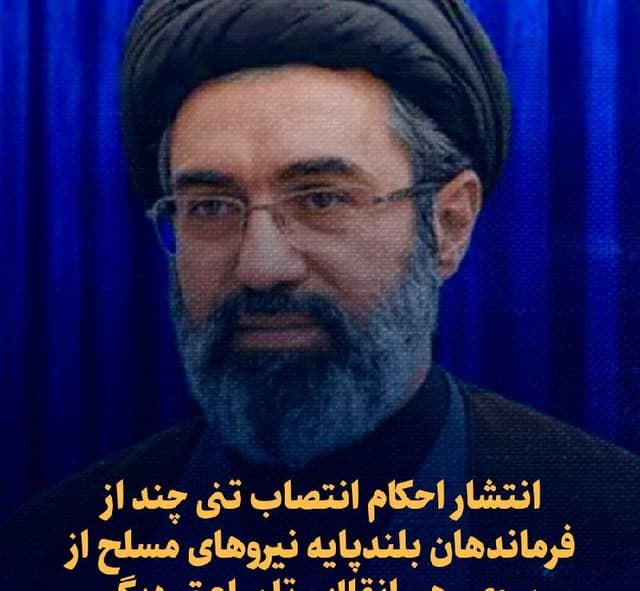
Orders attributed to Mojtaba Khamenei appoint six senior military commanders; Hossein Taeb officially returns to power
The office of the Supreme Leader of the Islamic Republic announced on Monday, 19 Mordad, that Mojtaba Khamenei had issued appointment orders for six senior armed forces commanders and called for preparations for a “powerful offensive operation” against the United States and Israel.
Under the orders attributed to Mojtaba Khamenei, Ali Abdollahi, formerly commander of the Khatam al-Anbiya Central Headquarters, was named chief of staff of the armed forces, while Kiomars Heydari was appointed his deputy. The previous chief of staff, Abdolrahim Mousavi, was killed in the first minutes of US and Israeli attacks on 9 Esfand last year. The Iranian armed forces’ general staff had continued operating without a chief for roughly the past five months.
Mousavi had replaced Mohammad Bagheri, the previous head of the staff, in the summer of last year. Bagheri was killed in Israeli attacks in Khordad last year, at the start of the 12-day war, along with several other senior military commanders of the Islamic Republic.
In his order appointing Abdollahi, Mojtaba Khamenei called for “completing the process of merging the armed forces’ general staff and the Khatam al-Anbiya Central Headquarters,” a “measure” that, he said, had begun under his father’s leadership. At the same time, he did not issue an order appointing a new commander of the Khatam al-Anbiya Headquarters alongside Abdollahi’s appointment as chief of staff.
Ahmad Vahidi, who became commander-in-chief of the Islamic Revolutionary Guard Corps after the outbreak of war and the killing of Mohammad Pakpour, received the rank of major general and an order appointing him commander of the powerful military, security and economic organization on Monday, under an order from the Supreme Leader of the Islamic Republic. Before the 40-day war began, he had been the IRGC’s deputy commander-in-chief.
Vahidi, a senior hard-line member of the IRGC, has previously commanded its Quds Force and is wanted by Interpol over alleged involvement in the bombing of the AMIA Jewish community center in Argentina. In addition to his military positions, he served for three years as interior minister under former Iranian President Ebrahim Raisi.
In the order issued in Ahmad Vahidi’s name by Mojtaba Khamenei, the Supreme Leader called for “the continuous and comprehensive enhancement of capabilities to ensure maximum deterrence, and intelligent readiness to carry out powerful offensive operations against the enemy.”
In a separate order, Mostafa Izadi was appointed deputy commander-in-chief of the IRGC. In another order, Mojtaba Khamenei appointed Ali Azmayi commander of the IRGC Navy, replacing Alireza Tangsiri, who was killed in Farvardin during the 40-day war.
Mojtaba Khamenei also named Hossein Taeb, the former head of the IRGC Intelligence Organization, commander of the Basij Organization. Taeb began his security career at the Ministry of Intelligence, was later pushed aside, and then established a parallel intelligence agency within the IRGC. He is described as a member of the old security and political circle around Mojtaba Khamenei, whose roots go back more than two decades.
Mohammad Sarafraz, the former head of the state broadcaster, has spoken about Mojtaba Khamenei’s behind-the-scenes role in shaping officials’ political decisions. Sarafraz, who was once a member of this circle himself, has described Mojtaba Khamenei’s direct relationship with Hossein Taeb and said that he was interested in Taeb’s intelligence reports.
Taeb was removed from the IRGC Intelligence Organization in Tir 1401, but reports describe him as an important figure close to Mojtaba Khamenei.
In his order appointing Hossein Taeb, Mojtaba Khamenei listed several priorities, one of which was “strengthening the popular intelligence network, improving skills and providing the necessary training alongside raising awareness, and using modern technologies to enable a people-centered response to enemy threats.”
He also called for fulfilling the slogan “Every Iranian, a Basiji,” by drawing on the Islamic Republic’s supporters—who have taken part in government-organized street rallies since the start of the 40-day war—to “protect the Islamic Revolution.”
📡 @VahidOnline