English
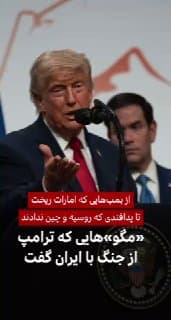
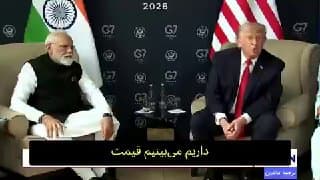
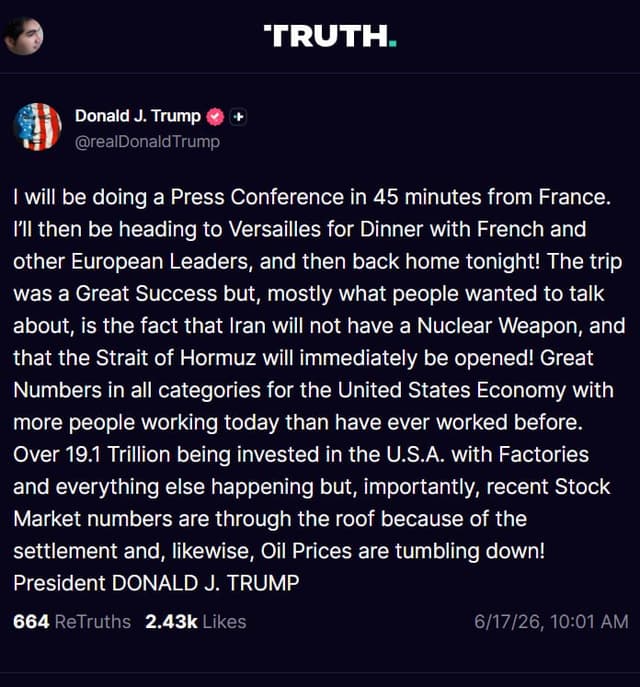
Trump’s press conference:
🔸 On Sunday, we reached an agreement with Iran that achieves everything we set out to achieve—everything and more.
🔸 If we hadn’t made this agreement, we could have dropped more bombs for 2 to 3–4 weeks, or even 2 years. You would never have seen the Strait of Hormuz open.
🔸 If I hadn’t killed General Soleimani, we probably wouldn’t be talking about this agreement now, because he was a crazy genius. They were never able to replace him.
🔸 World leaders are very happy that we reached an agreement, all of them. No country came to us and said, “Please, sir, drop the bombs on them. Please drop the bombs”—only stupid people say that.
🔸 Iran’s new leaders are smart, very smart. They’ve become much less radical. I think they really love their country. They’re good.
🔸 I didn’t want to see an economic catastrophe; if this had continued, it might have happened. Every time we talked about peace, the stock market went up. The stock market is smarter than anyone who’s here, including the people on this stage—except me.
🔸 The stock market is very brilliant. And every time we said something amazing, like “We’re going to make a deal,” the market went up. And every time—every time—we said something negative, like “Look what happened, we can’t make a deal,” the market went down—a lot, very, very much. That tells you something.
🔸 I didn’t want to be late like the great Herbert Hoover. I didn’t want that.
[ChatGPT: Herbert Hoover was U.S. president at the start of the Great Depression in 1929. In American political memory, Hoover symbolizes a president whose watch saw a crisis explode, and who was later accused of responding too late, inadequately, and with excessive caution. Even the shantytowns of the Depression era were mockingly called “Hoovervilles.” So Trump probably means: I didn’t want to wait so long that the crisis got out of control and then have everyone say the president acted too late.]
🔸 On the killing of Qassem Soleimani: It was a joint operation, as we say in the real estate business. It was a joint operation between Israel and us. We looked into it for a month. We knew almost a month in advance which plane he would be traveling on. He only traveled on commercial airlines, the big, crowded ones, because he knew we wouldn’t shoot him down. They’re very smart. But we knew he’d be on that plane, we tracked him, and then Israel informed me that they weren’t going to do it. And I had to make a decision. And I said to him, “Well, if Israel isn’t doing it, we’re all ready. Are we doing it? Do you want to do it or not?” I said, “Of course, if you want to do it, we can do it.”
🔸 On Netanyahu: Bibi Netanyahu is a good man. Sometimes he gets a little carried away, but he happens to be a very good man. We had a small disagreement about Lebanon—I said, “You can be a little gentler, Bibi. You don’t have to knock down a building every time somebody comes in; that’s Hezbollah’s job.”
🔸 Netanyahu came to the country and begged President Barack Hussein Obama not to do the JCPOA. He said it could be the end of Israel, and if I hadn’t gotten involved, it would have been. And Obama didn’t listen to him. Bibi actually went to Congress and begged them, but got nowhere. And they had this terrible agreement that was disastrous for Israel.
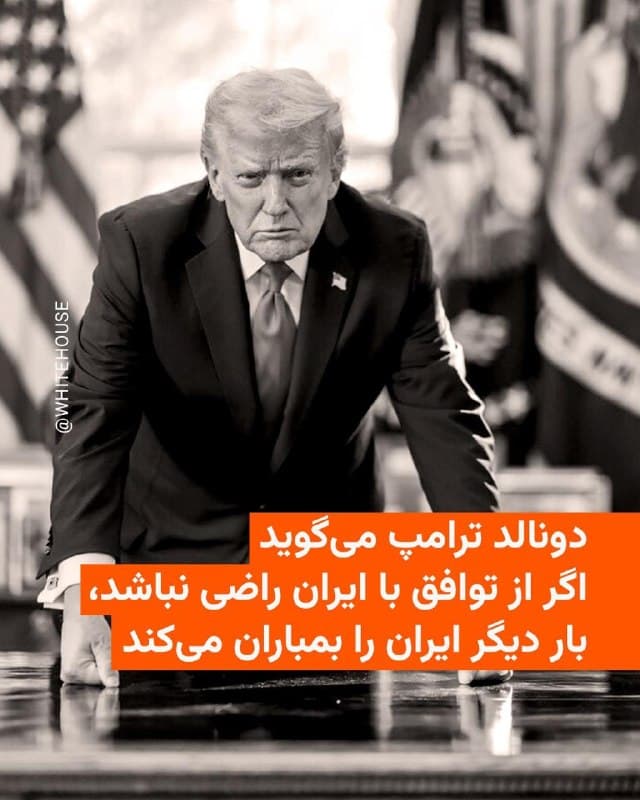
🔸 This is a memorandum of understanding. If it isn’t done in 60 days, that’s fine—we go back to bombing. You know, I don’t want to do that, because this is very good, very good. But, well, we may have to, because we will never let them have a nuclear weapon.
🔸 The agreement we reached with Iran on Sunday will be signed soon—tomorrow, maybe the day after.
🔸 Trump on Israel: I think they could do better on Hezbollah. I’m not saying they shouldn’t protect themselves, but—when two drones are fired into the desert and fall harmlessly, they don’t need to knock down buildings in Beirut. They can behave better. And honestly, they can do a better job—I like them, they’ve been a great partner, but they can do a lot better on Hezbollah.
🔸 Trump on Iran: Well, they need investment, because we caused one and a half trillion, maybe two trillion dollars’ worth of damage. So somebody has to help them—well, there’s no guarantee anyone will help them, and maybe their neighbors will help them a little, I don’t know, but that’s a lot of money. Almost nobody has that kind of money—that’s the kind of damage that was done.
🔸 They’re culturally primitive in one sense, but this primitive culture is genius. They’re very smart people and very good negotiators.
🔸 On missiles: We’re working on a parallel effort with the Gulf countries to address non-nuclear issues, like conventional ballistic missiles, which we’ll discuss and support. I mean, they should have some, because others have some, so you should have some too—someone said, “You shouldn’t give them one,” and I have people—some of these people I like, but I don’t think this—I don’t think they’re smart. “Of course, you shouldn’t let them have any missiles”—I said, well, what am I supposed to do, let Saudi Arabia have missiles, but not them? “Yes, sir.” That’s not how it works, you know, that’s not how it works, and missiles aren’t the problem—missiles hit a small place, but they don’t blow up the planet.
🔸 If they don’t respect the agreement, or if some things aren’t even mentioned in the agreement—this is a memorandum of understanding, but we have a shared understanding on some issues without putting it in writing—and if they don’t respect it, we’ll probably go back to bombing them until they do. You know, it’s amazing what bombs can do.
🔸 People want me to bomb bridges. I already did that, because, you know, they didn’t keep one of their promises and I bombed their biggest bridge, the equivalent of the George Washington Bridge in Iran. But we bombed that bridge—you saw it.
🔸 I want to thank China, President Xi. I was with him, and he remained completely neutral, completely neutral, and I appreciate that. And I want to thank Vladimir Putin; he was very neutral.
🔸 Well, the release of the money has an easy answer. We’ve taken a lot of their money, and we took their money from them. When it isn’t our money, it’s their money, and we froze it at a certain point. I think we should give it back, you know? If we didn’t give it back, nobody would ever invest in the dollar again.
🔸 Reporter: A wise man once said, in January 2020, “Iran has never won a war, but has never lost a negotiation.”
Trump: Who said that?
Reporter: Donald Trump.
Trump: Oh, I thought that’s what you were going to say.
🔸 If they raise the white flag of surrender and say, “Thank God Donald Trump is the greatest president in history,” The New York Times and CNN will say, “Iran achieved a great victory.”
🔸 By the way, the blockade was more effective than all the airstrikes, when we dropped a billion dollars’ worth of bombs on Iran.
🔸 Reporter: Why is it acceptable to you now that they retain part of their missile capability?
Trump: What are they retaining? They have less now than other countries. We probably disabled 84, 85 percent of their missiles. The rest are underground, and they can’t even get them out.
🔸 Trump on Iran: Do you want to let 91 million people starve to death?
🔸 Reporter: Can you say now whether anyone in your administration will be held responsible for the attack on a school that killed more than a hundred children on the first day of the war?
Trump: Mistakes happen. War is a terrible thing. I know it’s being investigated. I’ll ask Pete Hegseth, because they’re looking into it.
🔸 Reporter: Why aren’t you staying for the signing ceremony for the Iran peace agreement?
Trump: I might stay.
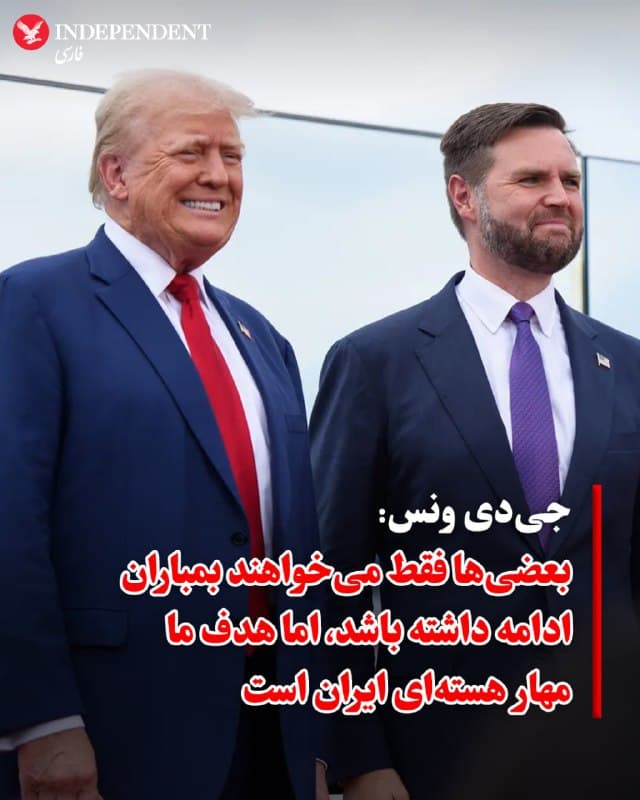
🔸 Reporter: Is there an element here where you send the vice president, and if he succeeds, great, you look like a genius for having sent him. And if he doesn’t succeed, it’s the vice president’s fault?
Trump: I like that idea. Well, that way, if he succeeds, I take the credit. If he doesn’t, it’s JD’s fault. You’d better watch out, JD. He’ll turn his plane around and run away from here. Yes, I like that idea. I think it’s a good idea.
📡 @VahidOnline I didn’t choose the sections above. I posted them as he was speaking, using foreign sources with machine translation.